
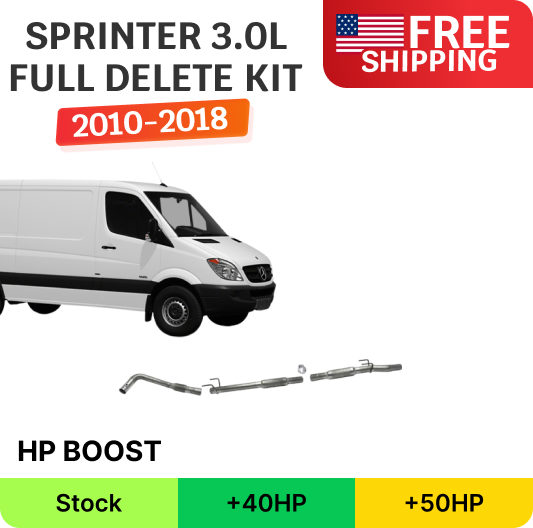
Mercedes Sprinter 2500 & 3500 3.0L | Full DPF, DEF, EGR Delete Kit | 2010-2018
Price range: $1,679 through $1,955
Description
2010-2018 Mercedes 3.0 Sprinter Delete Kit | Boost Power and Reliability
The 2010-2018 Mercedes 3.0 Sprinter delete kit is designed to enhance your vehicle’s performance by removing restrictive emissions systems. This All-in-One bundle includes components to eliminate the Diesel Particulate Filter (DPF), Exhaust Gas Recirculation (EGR), and Diesel Exhaust Fluid (DEF) systems. By doing so, it reduces backpressure and enhances exhaust flow, leading to potential power gains and improved reliability. Ideal for off-road use, this complete solution ensures your Mercedes Sprinter operates at its best.
What’s Included
- Bench-Flash Tuning — Custom ECM calibration with files are supplied for bench-flash programming. Stock, Stage 1 and Stage 2 tuning options are included to match the selected vehicle configuration.
- EGR Delete — The factory EGR system is disabled through custom bench-flash ECM tuning. Unlike many pickup applications, the OM642 platform does not require a physical EGR delete kit, as the EGR function is turned off within the engine calibration.
- DPF Delete Pipe — The Sprinter DPF delete kit includes a quality stainless-steel pipe that replaces the factory diesel particulate filter section, providing a more direct exhaust path.
- DEF/SCR Delete Components — Includes the required hardware and supporting calibration to remove the factory DEF and SCR systems from the emissions configuration.
- Installation Guide — A step-by-step guide explains the hardware installation and bench-flash tuning procedure for the complete package.
Exact bundle contents may vary depending on the selected product configuration and model year.
Vehicle Compatibility
| Specification | Details |
| Production Years | 2010, 2011, 2012, 2013, 2014, 2015, 2016, 2017, 2018 |
| Engine | Mercedes-Benz OM642 3.0L V6 Turbo Diesel |
| Models | Mercedes-Benz Sprinter 2500, Sprinter 3500 |
| Body Styles | Cargo Van, Passenger Van, Chassis Cab |
| Fuel Type | Diesel |
| Factory Emissions Equipment | DPF, DEF (SCR), EGR |
| Compatibility Notes | Not compatible with gasoline models or certain late-2018 vehicles equipped with a different factory ECM configuration. |
Before ordering, verify the production year, VIN, engine, and factory emissions configuration to ensure this kit matches your Mercedes-Benz Sprinter.
How It Works?
The 3.0 Sprinter delete kit replaces the factory DPF section with the supplied stainless-steel delete pipe while the ECM is updated using custom bench-flash tuning. The calibration disables the factory DPF, DEF/SCR, and EGR operating logic, so no physical EGR removal is required on the OM642 platform. This combination reduces exhaust restriction, simplifies the emissions system, and supports improved engine performance for supported off-road applications.
Kit Features
This complete bundle is engineered specifically for the Mercedes-Benz OM642 3.0L diesel platform and combines quality hardware with custom bench-flash tuning. The package includes a stainless-steel DPF delete pipe together with ECM calibration that disables the factory DPF, DEF/SCR, and EGR operating logic without requiring a physical EGR delete kit. Unlike generic solutions, this delete kit for Mercedes Sprinter is developed specifically for the factory engine management system, ensuring that the supplied hardware and tuning work together as a complete upgrade. The package offers reliable fitment, quality components, and calibration designed for supported off-road applications.
Available Tune Levels & Expected Gains
The 2010-2018 Sprinter delete kit includes two custom bench-flash calibrations developed specifically for the Mercedes-Benz OM642 3.0L diesel engine. Each tuning file is designed to match the installed hardware and provide predictable performance improvements for supported off-road applications.
Available Tune Levels
| Tune Level | Power Increase | Best For |
| Stock | Factory Output | OEM-like driving characteristics after the emissions modifications |
| Stage 1 | +40 HP | Everyday driving, commercial use, and improved drivability |
| Stage 2 | +50 HP | Maximum available performance for supported off-road applications |
Expected Characteristics
| Characteristic | Expected Result |
| Fuel Economy | May improve depending on driving style and operating conditions |
| Throttle Response | Improved compared to the factory calibration |
| Exhaust Flow | Improved with the supplied DPF delete pipe |
| Engine Performance | Increased power and torque through custom tuning |
| Reliability | May reduce maintenance associated with the factory emissions system |
| Towing Performance | May improve due to increased available torque |
Key Benefits
- Increased Power – The kit may enhance engine output by removing restrictive components.
- Improved Reliability – By eliminating emissions systems, potential failure points are reduced.
- Enhanced Exhaust Flow – The delete pipe allows for a more direct exhaust path.
- Fuel Efficiency – Users report potential improvements in fuel economy.
- Off-road Performance – Ideal for off-road applications, where emissions compliance is not required.
Installation Information
Installation of this Mercedes Sprinter DPF delete kit consists of two separate procedures: mechanical installation of the exhaust components and bench-flash programming of the factory engine control module (ECM).
Mechanical Installation
The factory DPF assembly is removed and replaced with the supplied stainless-steel delete pipe. During installation, the factory DPF, SCR/DEF (AdBlue), and related emissions components are removed or disconnected according to the supplied instructions. On the OM642 platform, the EGR hardware remains installed, while its operation is disabled through the custom ECM calibration.
Estimated mechanical installation time: 4–8 hours, depending on vehicle configuration, workshop equipment, and installer experience.
Bench-Flash ECM Programming
Unlike many pickup platforms that support OBD-II programming, the OM642 requires bench-flash tuning. The factory ECM must be removed from the vehicle and sent to our tuning facility.
After your order is placed, we provide a prepaid shipping label for your ECM. Once received, the module is inspected, programmed with your selected Stock Power, Stage 1 (+40 HP), or Stage 2 (+50 HP) calibration, thoroughly verified, and returned via express shipping.
Typical bench-flash processing time: 4–6 business days, plus 2–3 business days for return shipping.
During periods of high demand, additional quality-control checks may slightly extend processing time to ensure the calibration is completed accurately.
Please Note: Your prepaid shipping label remains valid for 60 days after issuance. Kindly ensure you ship your ECM within this timeframe. If your label expires before you can send the package, reach out to us for a replacement prior to shipping.
Before Installation
- Verify that your vehicle is equipped with the Mercedes-Benz OM642 3.0L engine and the EDC17CP46 ECM.
- Some early 2018 Sprinter models use the updated 2019-style turbo direct pipe, which is not compatible with this system. Confirm your configuration before ordering.
- If the ECM has previously been modified with aftermarket tuning, it should first be restored to the factory calibration before bench-flash programming.
- Carefully follow the supplied installation instructions when removing the factory emissions equipment and disconnecting the associated sensors.
Professional installation is recommended for customers who are unfamiliar with diesel exhaust systems or ECM service procedures.
Common Emissions Fault Codes Removed
After the supplied hardware has been installed and the custom bench-flash ECM calibration has been programmed, the updated engine management is designed to prevent diagnostic trouble codes associated with the factory DPF, DEF/SCR (AdBlue), and EGR systems. The exact coverage depends on the ECM software version and the supplied calibration.
Commonly addressed emissions-related fault codes include:
- P0401 – Exhaust Gas Recirculation (EGR) Flow Insufficient Detected.
- P0402 – Exhaust Gas Recirculation (EGR) Flow Excessive Detected.
- P2002 – Diesel Particulate Filter (DPF) Efficiency Below Threshold.
- P2033 – Exhaust Gas Temperature Sensor Circuit High.
- P208A – Reductant Pump Control Circuit/Open.
- P20EE – SCR NOx Catalyst Efficiency Below Threshold.
- P2453 – Diesel Particulate Filter Differential Pressure Sensor Circuit.
- P2463 – Diesel Particulate Filter Soot Accumulation.
FAQ
This kit is ideal for the 3.0 Sprinter 2010-2018 due to its comprehensive design and compatibility. It removes restrictive emissions systems, enhancing performance and reliability. The included tune files offer significant power gains, with options for +40HP and +50HP. Designed for off-road use, it ensures your Sprinter operates efficiently and powerfully.
The Bench-flash tuning offers precise ECM calibrations for optimal performance. This method ensures that the engine operates efficiently, with tune files tailored for power increases. The kit includes tunes for Stock, Stage 1 or Stage 2, providing flexibility in power enhancement. It supports the specific needs of the 3.0L OM642 Diesel engine.
Yes, installing this delete kit can increase power and reliability. By removing emissions systems, exhaust flow is improved, and potential failure points are reduced. The included tune files offer power increases of +40HP and +50HP, enhancing the vehicle’s performance. However, these gains depend on the vehicle’s condition and setup.
Towing performance may improve with this kit, as it enhances engine output and reliability. The increased power from the tune files supports better towing capabilities. With gains of +40HP and +50HP, your Sprinter can handle heavier loads more efficiently. This makes it ideal for off-road and utility applications.
Fuel economy may improve with the installation of this delete kit. By removing restrictive emissions systems, the engine can operate more efficiently. Users report potential fuel savings of up to 10% with the full delete and tune setup. However, actual improvements depend on driving conditions and vehicle maintenance.
 Mercedes Sprinter 2500 & 3500 3.0L | Full DPF, DEF, EGR Delete Kit | 2010-2018
Sorry, no reviews match your current selections

competition use only. It is not legal to use on public roads or
emissions-regulated vehicles. Learn more: Legal Disclaimer
© 2026 DieselBro. All rights reserved.
